
The question that framed my whole week was not mine. It was the title of the day two keynote: how do we bring event modeling to the 95%? Allard Buijze from AxonIQ put it on the screen, and it kept coming back around after that during side chats that happened around the conference.
The room was full of the converted. Everyone there had either been practicing this for years or had been curious enough to go do the research and come away convinced that this is the way, especially now, in the age of AI. That is maybe 5% of people who build software. The other 95% have never heard of it, or heard of it once and moved on. The whole future of the practice depends on them, and none of them were in the room.
So how do we reach them?
We don’t reach them directly
Here is the uncomfortable part. I don’t think we can get the 95% to show up voluntarily. Most people are not out there proactively hunting for a new method to change how they work. That is not a knock on anyone, it is just how it goes. Look at our own workplaces. Is everyone around us eager to move the cheese, to stir the pot, to change the way they have done things for years? Usually not.
So aiming the message straight at developers is aiming at the wrong target. If we want to sell developers on something, we don’t sell to developers. We sell to the people they answer to. The 95% will move when the people around and above them decide this is how the work gets done now, and not really before.
Which means the real audience is the managers.
Why it is worth the trouble now
The timing is the whole reason this matters more than it used to.
If we can describe how a system is supposed to work, how information flows through it, in a format that a normal human can read and actually verify, then we have written the exact thing we want to hand to an AI. The model becomes the blueprint. And when the blueprint is clear, the AI has no room to get creative and build something that was never asked for. We are not hoping it guesses right. We have drawn the fence.
That is a genuinely new reason to care about getting the WHAT written down properly. It used to be a nice-to-have. Now it is the input to everything that comes after.
The thing we keep getting wrong
Here is where I think even the 5% trip over our own feet.
An event modeling session is supposed to be about understanding the flow of information. That is it. It is not the place to implement the solution. But we can’t help ourselves. Because we already know this is going to become code, and probably code an AI writes, we try to make the model complete and technically correct from the very first minute. So we dive straight into the nitty gritty, and we get stuck there.
We did an exercise to model a restaurant, and it was funny, people still argued about how the thing should be laid out. There are so many ways to do it, and when the people in the room are not at the same level of experience, it gets heated fast. Someone lays something out, someone else says that is not technically correct, and off it goes. And that contention only ever happens in a room full of practitioners. The business folks would not have blinked. We manufactured the friction ourselves, by reaching for the HOW before we had finished the WHAT.
Broad strokes first
What would be great to see is a session that goes wide before it goes deep.
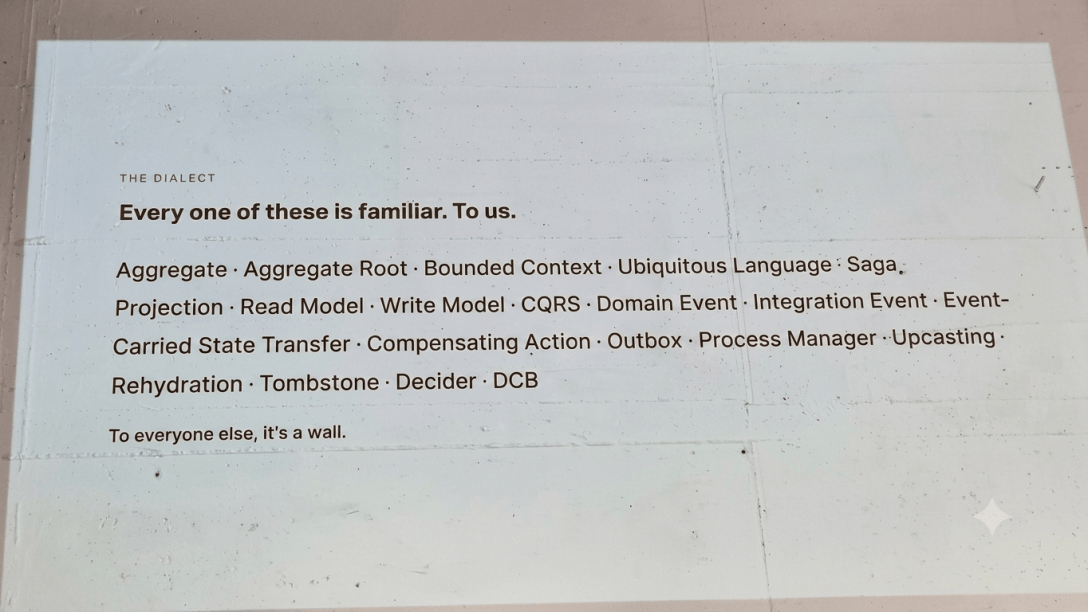
We want as much of the business input onto the board as fast as we possibly can. Broad strokes, an approximate story of how the thing is meant to work. The trick is not to stop and argue about the precise shape of anything yet. And honestly, we keep the technical vocabulary out of that room. This was one of Allard’s points in the keynote that stuck with me: there are words, the highly technical ones we practitioners love to reach for, that belong on a ban list for these sessions. We save them for the engineers and a later meeting. Every minute the room spends on a word only three people understand is a minute of everyone else’s time wasted, and it is exactly the moment a newcomer decides this is not for them.
The refinement comes later. That is a separate stage, with the engineers, where accuracy actually matters and the technical arguments are useful instead of alienating. Two stages, not one. First the shared story, then the precise model.
Why this is the version that spreads
When we split it like that, the whole thing stops being scary.
Most of the resistance to event modeling is the belief that it is complex and technical and only for a certain kind of expert. But almost none of that belief is about the modeling. It is about the implementation, and the implementation is the part we are deferring. If everyone in the early conversation shares a common understanding of what needs to be built, the how can be figured out afterward, and with a small handful of patterns it is not even that hard.
That is the pitch we can make to a manager. Not “learn this complex new discipline.” Just “let’s get everyone in a room and agree on what we are actually building, in plain language, before anyone writes a line of code.” That is not intimidating. That is the meeting they already wish they were having.
If we get the WHAT right, in words everyone can follow, and hand the HOW to the engineers and their agents, that is how we reach the other 95%.
And really, none of this is new. Leaving implementation out of the conversation and keeping the focus on the flow of information was the original intent of event modeling, the way Adam Dymitruk designed it. His original write-up describes it as “a non-technical way to show the intentions while allowing any implementation.” Somewhere along the way, as we got better at turning models into code, we let the HOW creep forward into the room. Getting back to the essence, the flow of information, is not some new idea we have to sell. It is a return to what event modeling was always meant to be.
P.S. Martin Dilger is already planning next year’s conference, in Munich in June, and the ambition is something like five times the size of this one. Here’s hoping we get some of the 95% in the room this time. If you are curious, you can join the waiting list here.


