
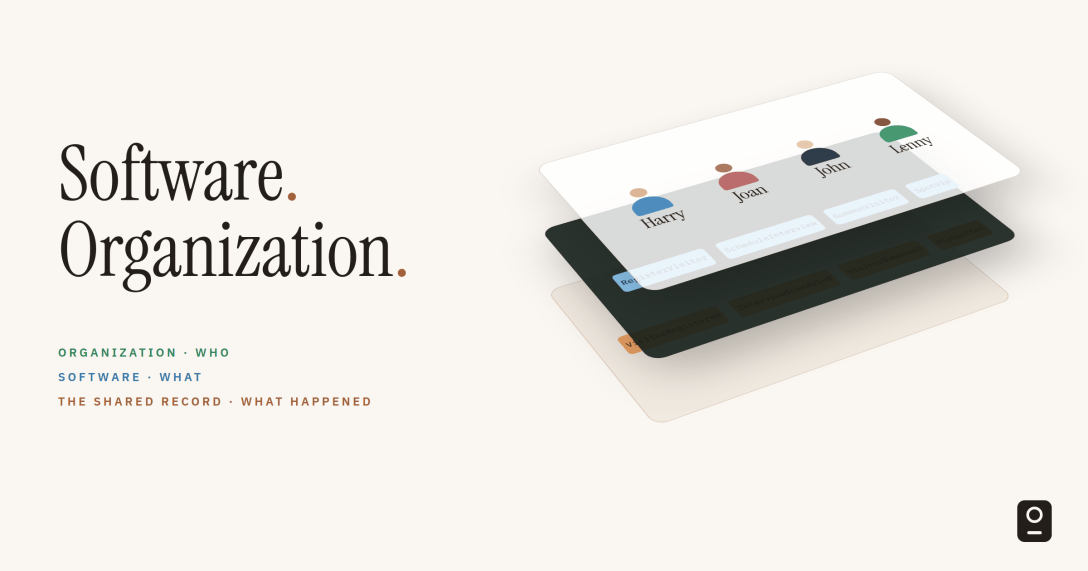
“Any organization that designs a system will produce a design whose structure is a copy of the organization’s communication structure.” Melvin Conway, 1967
If your org is going to end up in your code anyway, you might as well pick the org.
Throughout my career, I’ve been exposed to different organization structures and different company sizes. I’ve started thinking about how much alike software and organizations actually are.
I’ve been in a big enterprise where numbers were what mattered. Each role had a KPI that they worked towards on a continuous basis. Relatively flat, contributors that each had a focus area.
When I went into software development, it was a team working towards one thing, with many people contributing to the delivery of a feature.
I also had different types of bosses. There were those that micromanaged and liked to tell people what to do. I have had good micromanagers. They were the ones that had a bigger plan in mind but liked to be in the trenches with the people that made things happen, in order to get the desired outcome.
I also had the bad micromanagers, the ones that just yelled about the results they wanted without the interest or the desire to understand how we got there.
When working in a team, when the goals are clearly defined, and you have good people in the team that you can trust to deliver, that’s when there is less stress in delivery.
I look at the individuals that I have worked with throughout my career. There are the ones that tell you that’s beyond their scope, there are the ones that go out of their way to help others, and there are the ones that find the balance of both, finding a way to help you as long as it brings them forward in their own interests.
Then I think about how the code I write has changed throughout the years.
The very first real piece of software I wrote was a snake game in Java. A group of friends and I had just started computer science and we challenged each other to write snake in whatever language we enjoyed the most. I picked Java. I liked object oriented programming because I could code things in a way that made sense to my brain. The board draws itself, given certain dimensions. Food spawns in a grid given the allowed set of coordinates and constraints. The snake has its own properties to keep track of where it is, given a tick of time and input received.
Fast forward to when I was building ‘serious’ apps, I gravitated to DDD and SOLID because they made sense in my mind. I wouldn’t write one long transaction script if I could break it down into smaller classes that did one thing, took care of their own concerns, and regrouped before we went to persistence.
I always thought about it like instructing people when I am in charge of getting something done.
If you have something that you do once, that’s fine. But if you do the same thing often, maybe not in the exact same way, you want to give sub instructions to people whose jobs never change, so you have time to focus on giving special instructions for the thing that’s different about this new execution.
If you’re good at breaking down tasks and optimizing your resources, you just need people that can follow instructions perfectly, or ask you for guidance when needed, and your daily operations are going to run fairly smoothly. As long as your long term goal is doing mostly the same thing over and over again.
What if you get a team, and instead of giving them explicit instructions, you give them access to all your company information, and you give them rules instead?
Harry, you have one job. If someone enters this room, save their name, contact number and the purpose of their visit, so anyone in the company can access it.
Joan, find all the people who are here for an interview and schedule them in available rooms. When Joan is done, she makes a note available to the entire company about where she scheduled people, for which time, in which room.
John’s job is to summon the visitor, 5 minutes before their scheduled interview. He notes down that the person has arrived at the room for the interview. He might even note what time that person stepped into the room.
Then one day a VIP walks in.
In the old setup, that’s a meeting. The boss rewrites everyone’s instructions, Harry has to learn to spot VIPs, Joan has to learn to keep a room free just in case, John has to learn who gets fetched first, and for a while nobody is quite sure whose job it is.
In this team, Harry writes the VIP down like anyone else. We bring in Lenny. Lenny has one job: he checks Harry’s notes against the VIP list, and when there’s a match, he lets the CEO know and books the best room. Joan sees the room is taken and schedules around it, like she always does. Nobody else has to change.
Each of them has one job, and none of them needs to know how the others do theirs. I used to get irked by the people who said “that’s beyond my scope.” Turns out they had it right all along.
That’s how I write code now. Harry, Joan, John and Lenny don’t watch everything. Each of them guards one gate: they check what has already happened, decide what happens next, and write it down for everyone else to see.
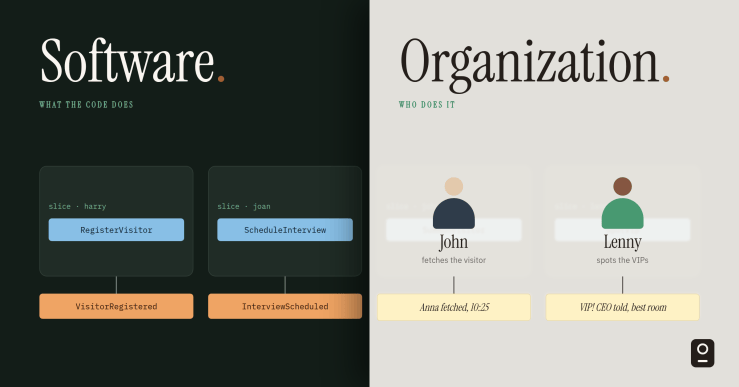
Real software is the one that takes the least effort to adapt to a new situation, a new requirement, without needing a reorg just to do it. In code, we call that reorg the big refactor.
So pick the org you’d want to work in, and write your code like it.


