
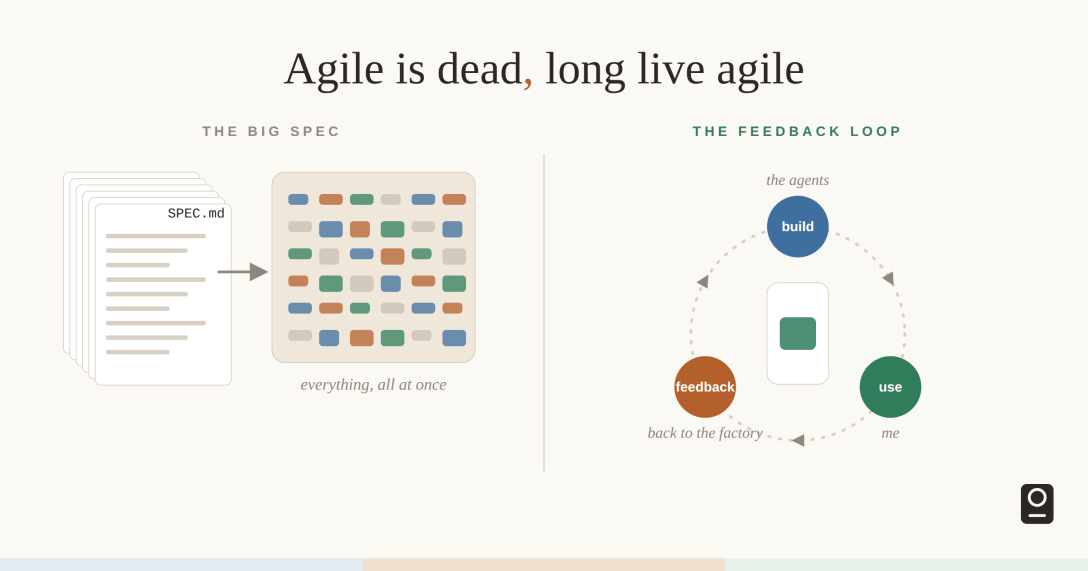
I see a lot of sentiment for and against agile. But what I’m finding in my own personal workflow is that it is very much aligned to the agile way. If I have understood agile correctly.
What I hear people say is that agile is no longer the way to go. Some people seem to think that the way to go is go all in to a spec, a massive spec, and send it to the factory to build, because the agents can build stuff unattended now. So we might as well go back to waterfall.
I actually don’t believe so, although I think enterprises should definitely revamp the way they work. The delivery part is going to be handled by the agents, it’s the feedback loop that we need to be focusing on.
The way I work with my AI agents seems to be in line with the agile way, except my job has become more of the product owner than the developer.
To me it means the continuous process of making something small enough to validate, and verify that it actually adds value, give feedback and iterate.
I wanted to build an app to manage TV time at home among the kids (and us parents). I tried to make the TV booking app with all the features up front in a big plan. And everything got built, but I didn’t ever know how to go about testing it. We came up with a mega UI that could do all the things, but made me unsure where to start. The resulting UX was one big interface. Sure, it hadn’t gone through the refinement of design, which could probably be another cycle, but by then it just felt very overwhelming to have all the features in context.
That’s contrary to my other apps, where I start with one problem, which organically grows features out of the ones that I know actually work.
I scope the spec to one key thing, which people would call the MVP I think. And then grow from there.
Going feature by feature and taking the time to verify and scrutinize the experience allows you to actually refine the user experience, change direction, etc. Sure, functionality can be defined, but it’s not until you use something that you really get a feeling whether it works or makes sense.
The factory can mass produce the parts, but people need to put things together and test drive the product, and make sure that feedback gets back to the factory for further improvements. And the factory better be prepared to pivot.


